Part 8.1 — Why GraphQL Exists: Problems It Tries to Solve
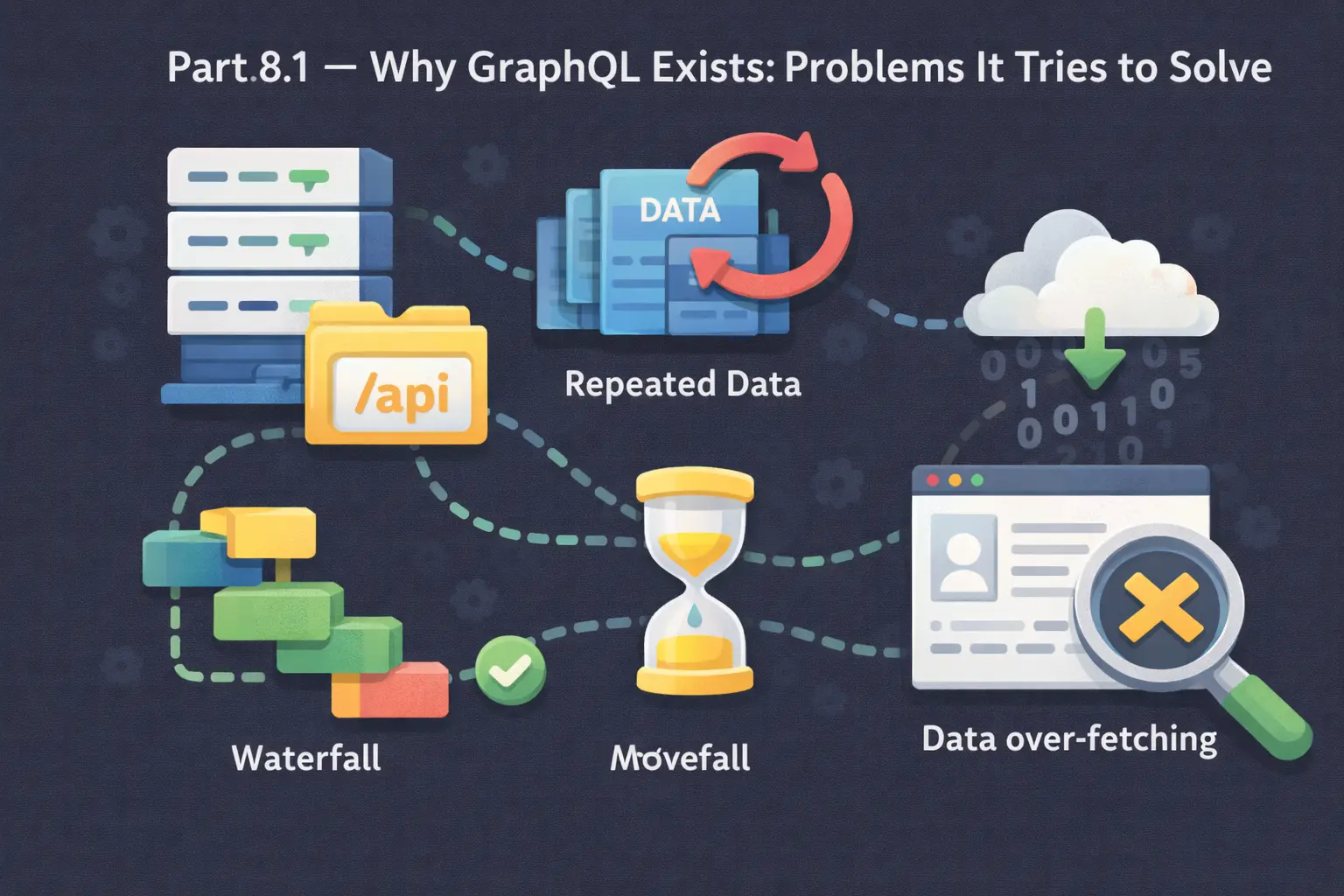
GraphQL did not emerge because REST is “bad.”
It emerged because API design often ignored how clients actually consume data.
To understand GraphQL properly, you have to stop thinking in terms of technologies and start thinking in terms of pain. This post explains the real problems GraphQL was created to solve—and why those same problems can still exist today, even if you never touch GraphQL.
1. The Original Pain: Mobile Clients
GraphQL was born inside Facebook, in a world where:
mobile networks were slow
devices were underpowered
apps needed precise data control
backend teams moved slower than frontend teams
The core issue was not protocol choice.
It was client dependency on server decisions.
2. Over-Fetching: Getting More Than You Need
Classic REST problem:
GET /users/42Response:
{
  "id": 42,
  "name": "Alice",
  "email": "alice@example.com",
  "address": "...",
  "preferences": "...",
  "settings": "...",
  "auditLogs": [...]
}
The client only needs:
idname
But it receives everything.
Problems:
wasted bandwidth
slower parsing
tighter coupling
accidental data exposure
Over-fetching isn’t just inefficiency—it’s loss of control.
3. Under-Fetching: Not Getting Enough
The opposite problem:
GET /postsReturns:
[{ "id": 1, "title": "Hello" }]Now the client needs:
author name
comment count
So it makes more calls:
GET /posts/1
GET /users/9
GET /posts/1/comments
Problems:
multiple round trips
waterfall requests
fragile client logic
Under-fetching forces clients to orchestrate the backend.
4. The Real Problem: Fixed Responses
Traditional REST endpoints return fixed shapes.
That means:
server decides what data looks like
clients adapt or work around it
adding fields risks breaking consumers
GraphQL’s core idea was simple:
Let the client ask for exactly what it needs.
Everything else follows from that.
5. Frontend Teams Move Faster Than Backends
Another root cause: team structure.
Common reality:
frontend ships weekly
backend ships monthly
API changes are gated
clients are blocked
GraphQL shifts responsibility:
backend defines capabilities
frontend composes queries
This decoupling is powerful—but costly.
6. Multiple Clients, Conflicting Needs
One backend, many consumers:
web app
mobile app
admin dashboard
third-party integrations
Each wants:
different fields
different nesting
different performance trade-offs
REST often responds by:
adding more endpoints
adding more versions
adding flags and hacks
GraphQL responds by:
exposing a flexible graph
letting clients shape responses
Again: flexibility vs complexity.
7. REST Was Never the Villain
Here’s the uncomfortable truth:
Most GraphQL “wins” come from fixing bad REST APIs.
Problems blamed on REST are usually caused by:
poorly designed endpoints
lack of DTO discipline
server-centric thinking
ignoring client usage patterns
REST itself never forbade:
sparse responses
nested includes
pagination
field selection
They were just… not enforced.
8. GraphQL Is a Response to Process, Not Protocol
GraphQL solves:
coordination problems
versioning anxiety
client-server friction
It does not magically solve:
N+1 queries
authorization complexity
caching difficulty
operational overhead
Those problems still exist—just in different places.
9. The Hidden Costs GraphQL Introduces
Before romanticizing GraphQL, understand the trade-offs:
more complex tooling
harder caching
complex auth rules per field
runtime query cost analysis
new failure modes
GraphQL shifts complexity—it does not remove it.
10. Why This Part Still Teaches REST Only
In this program, we keep:
PostgreSQL
Prisma
NestJS
REST APIs
On purpose.
Because most GraphQL benefits come from:
better API design
client-aware responses
intentional data modeling
All of which you can do with REST—cleanly and predictably.
11. The Mental Shift That Matters
The real lesson of GraphQL is this:
APIs should serve client needs, not backend convenience.
Once you internalize that, your REST APIs start to:
shrink
clarify
stabilize
scale better
The tool matters less than the mindset.
12. What Comes Next
In the next post, you’ll learn:
how GraphQL thinks in schemas and resolvers
how those ideas map directly to
REST controllers
services
DTOs
No GraphQL implementation.
No schema language.
Just clear mental models you can apply today.
Related
Part 8.6 — When (and When Not) to Use GraphQL in Real Systems
GraphQL is powerful—but expensive. This post helps you decide, based on real constraints, whether GraphQL is worth adopting or whether REST will serve you better.
Part 8.5 — Backend Architecture: Controllers vs “Resolvers” in NestJS
If you squint a little, a NestJS controller method already is a resolver. This post shows how to embrace that idea without introducing GraphQL complexity.
Part 8.4 — Client-Driven Data with REST: Avoiding Over-Fetching
Over-fetching is a client problem as much as a server problem. This post shows how React apps can drive data needs intentionally—without turning REST APIs into guesswork.
Comments